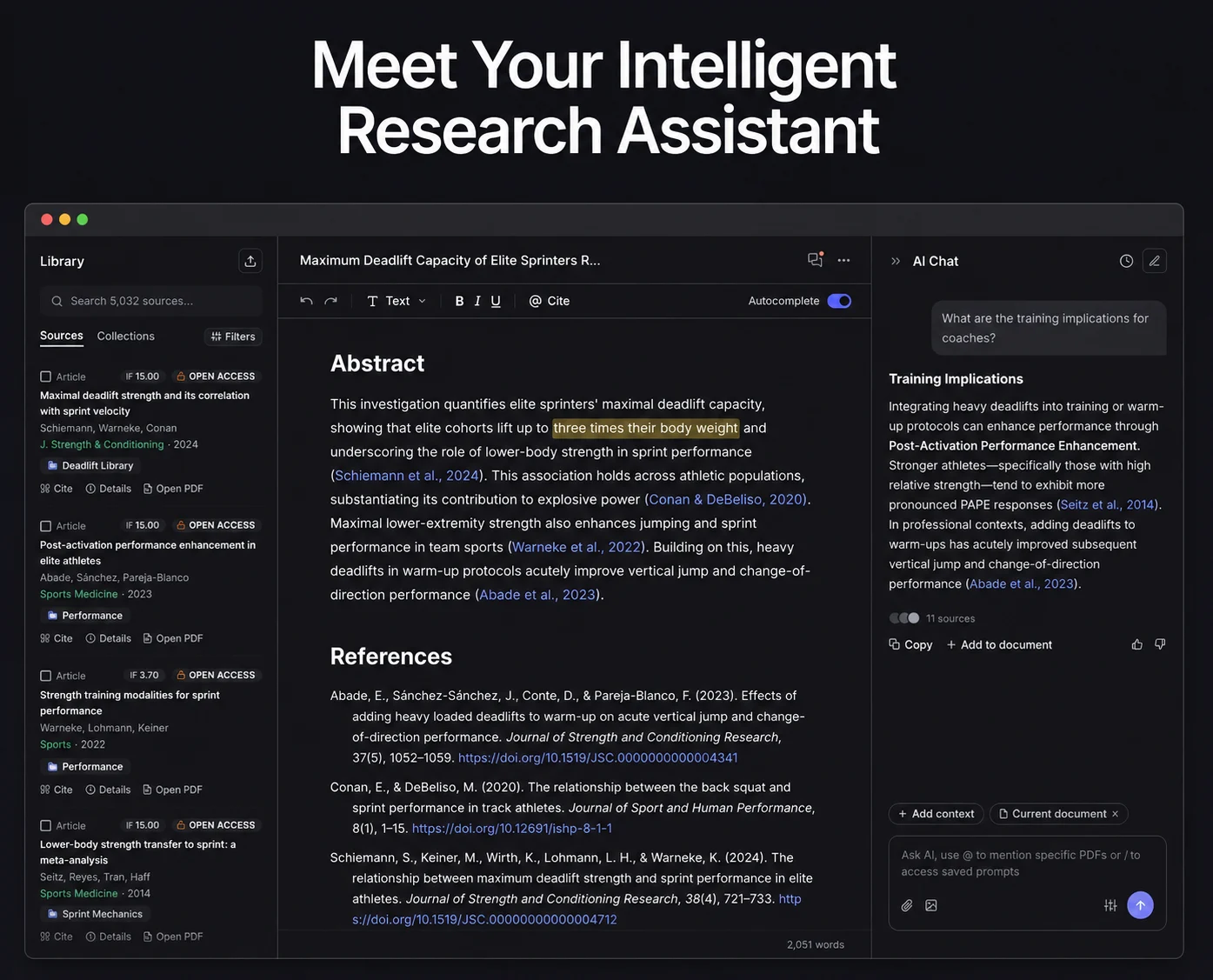
Jenni is a browser-based writing workspace built for academic work - no prescription-strength jargon, no guesswork, every AI suggestion traceable back to a real page in a real PDF.
None of this is about effort. It's about doing citation work manually that a workspace should be doing for you.
You've got twelve tabs open and still can't find the one line that backs up your thesis statement.
It's midnight, the draft is due tomorrow, and you're still manually converting footnotes to APA.
A reviewer circles a sentence and writes "source?" - and you genuinely can't remember where it came from.
You tried a generic chatbot and it invented a confident, well-written paragraph with zero real citations.
You're emailing a Word doc back and forth with a co-author, and nobody's sure which version is current.
You know the perfect paper exists somewhere in 200 million publications - you just can't find it by keyword.
This happens because academic writing was built around two disconnected jobs: finding sources and writing sentences. Every tool that split those jobs into separate tabs also split your attention, so citation work becomes a manual, error-prone chore layered on top of the actual thinking.
Jenni AI was built to close that gap. It keeps your sources, your writing, and your citations inside one workspace, so the AI suggesting your next sentence already knows which paper it's pulling from.
Jenni is an AI research and writing assistant built specifically for essays, theses, and academic papers. You upload or search for sources, and Jenni's autocomplete suggests sentences grounded in that material, with a citation attached to each one automatically.
That's different from asking a general chatbot for a paragraph. A chatbot answers from broad training data with no traceable source. Jenni answers from documents you chose, and shows you exactly where each claim came from so you can check it before it ever reaches your professor or a peer reviewer.
Real students, PhD candidates, and university research teams across the world use it daily to move from a blank page to a properly cited draft.
Every feature below exists to keep your writing traceable back to a real source.
Every AI-suggested sentence links to the exact page and paragraph of the source PDF it came from, so you can verify it in one click instead of hunting back through a stack of papers.
Verify in one clickSemantic search runs across more than 200 million academic sources, surfacing relevant papers even when you don't know the exact keyword to search for.
200M+ sourcesAsk questions about a methods section, compare findings across multiple papers, or find which source discusses a specific concept - answered with citations pulled from your own library.
Cited answersDrag in PDFs directly or bring an existing reference manager library across in seconds, so you're not rebuilding your research from scratch.
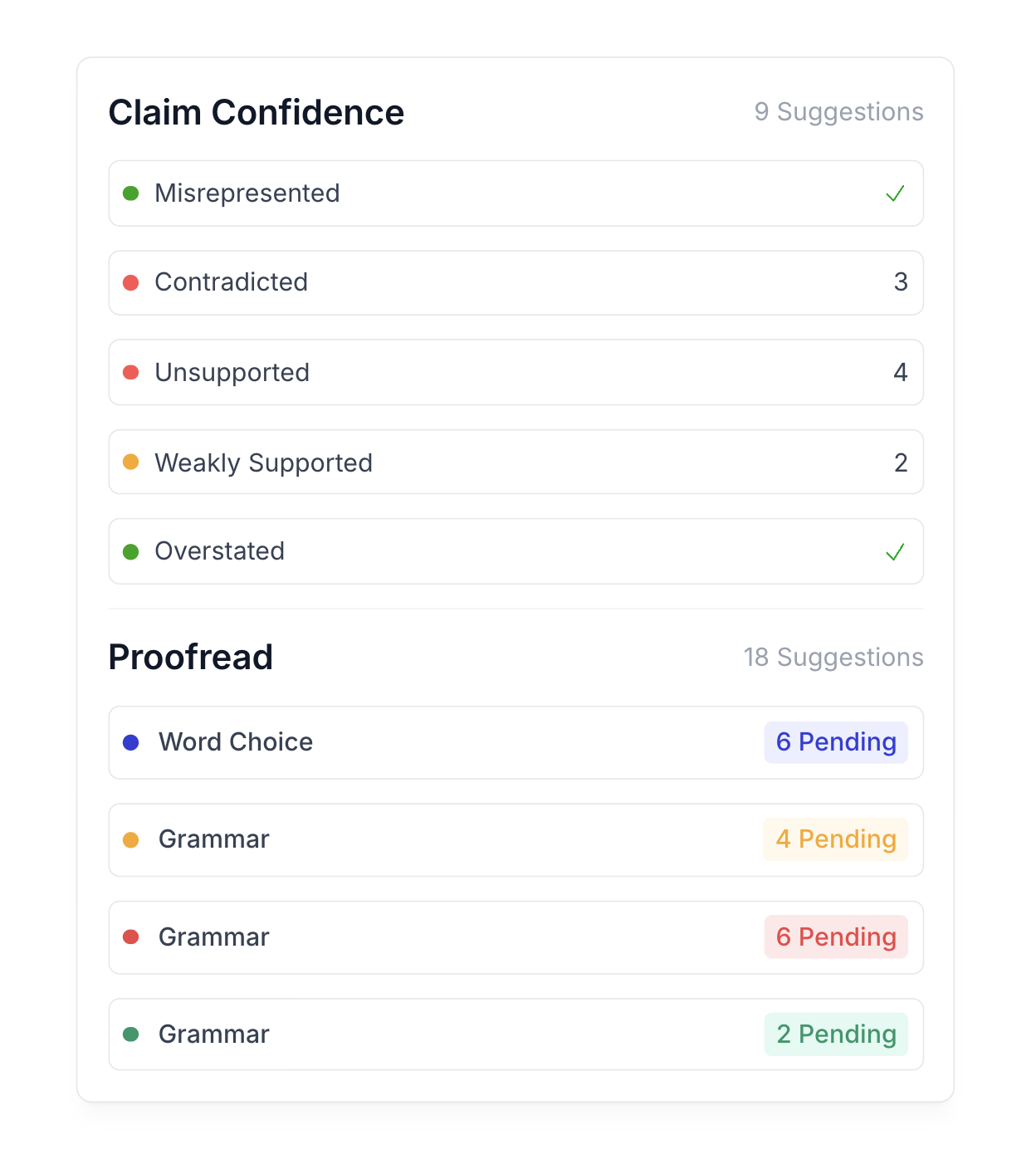
Seconds, not hoursBefore you submit, Reviews cross-references every claim against your cited sources and flags unsupported, contradicted, or overstated statements across six categories.
Catch issues earlyCo-author with a supervisor or research partner in the same document, with inline comments and version history, instead of emailing Word files back and forth.
No more email chainsThe order matters - each step feeds the next so citations stay attached to your writing automatically.
Drag in PDFs, import from Zotero or Mendeley, or let Jenni search 200M+ papers. Your library is ready in seconds.
Autocomplete suggests sentences grounded in your selected papers. Every suggestion is cited and traceable back to the source.
Generate citations in one click across 10,000+ styles, run Reviews to catch weak claims, then export to .docx, LaTeX, or HTML.
This is the version of writing where the source is never the missing piece.
You close your laptop at a reasonable hour because the reference list built itself as you wrote.
Every claim in your draft already has a source attached, so a reviewer's "citation needed" never lands on your desk.
You spend your energy on the argument, not on remembering which of eleven tabs had the right statistic.
Your supervisor edits the same live document you're writing in, instead of a week-old attachment.
You find the exact paper you needed in a search bar, not a library database with three login screens.
Submission day feels routine, because Reviews already caught the weak claims before anyone else did.
No credit card required. Cancel anytime.
Quotes below are drawn from named users featured on Jenni's own site. The final two slots are reserved for reader-submitted reviews, verified before publishing.
Michelle describes Jenni as a research assistant that's always available - support that used to depend entirely on waiting for a supervisor's feedback.
Gareth, an editor-in-chief at Taylor & Francis, says Jenni has been the easiest AI research tool he's tried, particularly for reformatting references quickly.
Dr. Josmel Mendoza highlights the library chat feature - asking questions directly against uploaded PDFs - as the part that keeps his writing organized across sources.
[ Reserved - verified reader review to be added ]
[ Reserved - verified reader review to be added ]
[ Reserved - verified reader review to be added ]
Jenni's free plan is enough to try the full workflow. Upgrade later only if you need higher usage limits - see current plan details on Jenni's own pricing page.
Unsupported or speculative claims are one of the most common reasons a paper gets flagged in peer review. Reviews checks every claim in your draft against your own cited sources and sorts issues into clear categories.
Academic tools have a track record of overselling what AI can actually do, and it's fair to be skeptical of another one showing up in your inbox.
Jenni doesn't ask for a card to start. You sign up, connect or upload sources, and use the full source-grounded writing workflow on the free plan before deciding whether a paid tier is worth it for you.
If it isn't the right fit, you simply stop using it - there's no subscription commitment locking you in from day one.
Try It FreeNo fluff - here's what actually matters before you sign up.
Most general AI tools write from broad training data with no traceable source. Jenni writes from documents you select, so the output is grounded in your own research rather than a generic guess.
Jenni supports multiple languages, so you're not limited to writing and citing in English only.
Most of the time saving shows up in the first session - importing a library and getting your first cited paragraph typically takes minutes, not hours.
No card is required to start on the free plan. Paid tiers exist for heavier usage, but you choose to upgrade - nothing is charged automatically at signup.
No. Jenni is a structured writing workspace with a library, citation engine, and claim-checking tool built around your sources - not a single chat window.
Jenni supports more than 10,000 citation styles, including journal-specific formats, so most academic requirements are covered out of the box.
Jenni AI is a browser-based writing workspace built for academic and research work. It suggests text grounded in your own uploaded sources, generates citations automatically, and lets you search hundreds of millions of papers without leaving the editor.
Jenni links each AI-suggested sentence back to the exact page and paragraph of the source PDF it came from, so you can verify a claim in one click. It supports more than 10,000 citation styles, including APA, Chicago, Harvard, IEEE, and Vancouver.
Jenni is built to draw from the sources you upload or select rather than generic training data, and it shows you the source behind each suggestion so you can check and rewrite it in your own words before submitting any work.
Jenni offers a free plan you can start with no credit card required. Paid plans with higher usage limits are listed on Jenni's pricing page.
Yes. Jenni includes semantic search across more than 200 million academic sources, plus direct access to tens of millions of full-text open access papers, without switching tabs or tools.
Yes. You can drag in PDFs directly or import an existing library from Zotero or Mendeley, and Jenni organizes it into a searchable library inside the editor.
Finished documents can be exported to .docx, LaTeX, or HTML, so you can move your work into the submission format your journal or institution requires.
Jenni's Reviews tool cross-references every claim in a draft against your cited sources and flags issues such as unsupported, contradicted, or overstated claims before you submit for peer review.
Yes. Jenni supports real-time co-authoring, inline comments, and version history, so a supervisor or co-author can review and edit the same document without emailing files back and forth.
Jenni is built for graduate students, PhD candidates, university research labs, academic teams, policy analysts, market researchers, and clinical or medical writers who need cited, source-grounded writing.
Every hour spent reformatting a reference list is an hour not spent on the argument that actually matters. Jenni keeps the sources with you as you write, so the paper gets finished instead of stalled.